Soil isn't just "plain ol' dirt". Soils are complex systems with a diverse physical and chemical make up.
This
make up is incredibly variable and can change how pesticides interact with the environment. Things like the
soil
texture and type, amount of water present, temperature, and the way that a pesticide is applied can all play
a
role in a pesticide's potential to bind to soil. These factors can change from one place to the next. This
makes
it difficult for scientists to report binding affinity values that can be broadly used for all
situations.2
Just because a pesticide has a high potential to bind to soil particles doesn't mean that it will do so in
all
types of soil. Soils that have lower clay content and/or organic matter, for example, aren't very attractive
to
pesticides. Why is that?
To start, the amount of sand, silt, and clay in a soil give it a unique texture. The more sand and silt a
soil
has, the less attractive it is to an organic (carbon-based) pesticide. This is because the sand and silt
particles (large and medium sized particles) don't have places for these pesticides to bind. Clay soils, on
the
other hand, are made of small particles that are electrically charged. Clay particles also have many layers
that
attract and trap organic matter. This means that many types of pesticides can be attracted and bind to clay
particles.3
Soil organic matter also plays a role in how well
pesticides
bind. Organic matter is
broken down plant material like fats, carbohydrates, proteins, and waxes. It is structurally complex and
provides lots of places where water and pesticides can be held.3 So,
soils
that have more organic
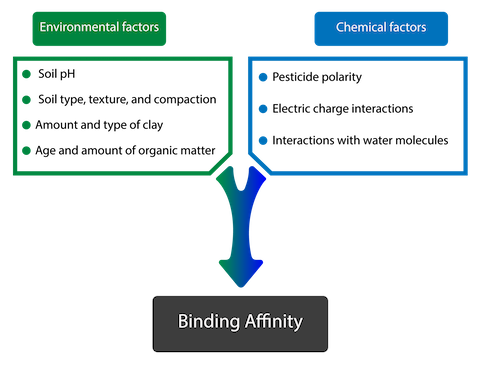
matter and clay are better able to hold on to pesticides. For a list of some factors that can affect binding
affinity, see Figure 1.