1.800.858.7378npic@oregonstate.edu
Call, email, or chat Mon-Fri
A to Z
Permethrin Technical Fact Sheet
As of 2011, NPIC stopped creating technical pesticide fact sheets. The old collection of technical fact sheets will remain available in this archive, but they may contain out-of-date material. NPIC no longer has the capacity to consistently update them. To visit our general fact sheets, click here. For up-to-date technical fact sheets, please visit the Environmental Protection Agency’s webpage.
- Chemical Class and Type
- Physical / Chemical Properties
- Uses
- Mode of Action
- Toxicity Classification
- Acute Toxicity
- Chronic Toxicity
- Endocrine Disruption
- Carcinogenicity
- Reproductive and Teratogenic Effects
- Fate in the Body
- Medical Tests and Monitoring
- Environmental Fate
- Ecotoxicity Studies
- Regulatory Guidelines
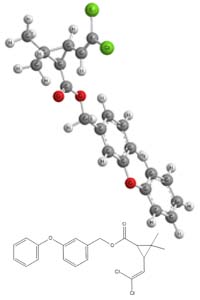
Molecular Structure -
Permethrin
Chemical Class and Type:
- Permethrin is an insecticide in the pyrethroid chemical family. The International Union of Pure and Applied Chemistry (IUPAC) name for permethrin is 3-phenoxybenzyl (1RS,3RS;1RS,3SR)-3-(2,2-dichlorovinyl)-2,2-dimethyl-cyclopropanecarboxylate and the Chemical Abstracts Service (CAS) registry number is 52645-53-1.1 Permethrin is considered a type I pyrethroid.2
- Permethrin was originally registered for use by the United States Environmental Protection Agency (U.S. EPA) in 1979, and it was re-registered in 2006.3 See the text box on Laboratory Testing.
- Permethrin is a blend of two stereoisomers.1 Details on the ratio used in a specific product may be listed on the label, or may not be readily available. For the remainder of this fact sheet, note that permethrin refers to an isomer blend and not one isomer alone.
Physical / Chemical Properties:
- Technical permethrin ranges from a colorless crystal to a yellow or brown viscous liquid.1,2 No information on the odor of permethrin was found.
- Vapor pressure2: 2.15 x 10⁻⁸ mmHg
- Octanol-Water Partition Coefficient (Kow)1: 6.1 at 20 °C
- Henry's constant2: 1.4 x 10⁻⁶ atm·m3/mol
- Molecular weight1: 391.3 g/mol
- Solubility (water)1,2: 5.5 x 10⁻³ mg/L, 6 x 10⁻³ mg/L
- Soil Sorption Coefficient (Koc)4: 1.00 x 10⁵
Laboratory Testing: Before pesticides are registered by the U.S. EPA, they must undergo laboratory testing for short-term (acute) and long-term (chronic) health effects. Laboratory animals are purposely given high enough doses to cause toxic effects. These tests help scientists judge how these chemicals might affect humans, domestic animals, and wildlife in cases of overexposure.
Uses:
- Permethrin can be used in public health mosquito abatement programs and on a variety of food or feed crops and livestock; or in structures and buildings, including livestock housing and food-handling establishments. Permethrin can also be used in numerous residential sites, both indoor and outdoor, and on pets and clothing. When permethrin is used on large areas like crops, nurseries, and sod farms it is considered a restricted use pesticide. For other applications, it is considered a general use pesiticide. Formulations of permethrin used for treatment of head lice and scabies on humans are available, but these are considered pharmaceuticals, which are regulated by the United States Food and Drug Administration (FDA).2 Uses for individual permethrin products vary widely. Always read and follow the label when applying pesticide products.
- Signal words for products containing permethrin may range from Caution to Danger. The signal word reflects the combined toxicity of the active ingredient and other ingredients in the product. See the pesticide label on the product and refer to the NPIC fact sheets on Signal Words and Inert or "Other" Ingredients.
- To find a list of products containing permethrin which are registered in your state, visit the website http://npic.orst.edu/reg/state_agencies.html select your state then click on the link for "State Products."
Mode of Action:
Target Organisms
- Permethrin acts on the nervous system of insects. It interferes with sodium channels to disrupt the function of neurons, and causes muscles to spasm, culminating in paralysis and death.1,2
- Permethrin can be effective by contact or ingestion and also acts as a mild repellent.1
Non-target Organisms
- Permethrin is highly toxic to honeybees, fish, and aquatic invertebrates due to disruption of sodium channels.1,3,5
- In general, mammals are less susceptible to permethrin compared to insects because their sodium channels are less sensitive to pyrethroids and recover more rapidly. Also, because of their larger body size and greater metabolic capabilities, mammals are more likely to metabolize pyrethroids, such as permethrin, before they can affect the nervous system.5,6 Conversely, cats can be sensitive to products with high concentrations of permethrin, possibly due to insufficient glucoronide conjugation capability, which hinders the metabolism of permethrin.7,8
Acute Toxicity:
Oral
- In rat studies, permethrin LD50 values range from 430-4000 mg/ kg. Permethrin LD50 values for mice range from 540-2690 mg/ kg. Factors contributing to the variability of these values include age, sex, carrier and isomer ratio.1
- The U.S. EPA considered permethrin to be low in toxicity for acute oral exposure based on an acute oral LD50 range of 2280- 3580 mg/kg in rats.2 See the text boxes on Toxicity Classification and LD50/LC50.
LD50/LC50: A common measure of acute toxicity is the lethal dose (LD50) or lethal concentration (LC50) that causes death (resulting from a single or limited exposure) in 50 percent of the treated animals. LD50 is generally expressed as the dose in milligrams (mg) of chemical per kilogram (kg) of body weight. LC50 is often expressed as mg of chemical per volume (e.g., liter (L)) of medium (i.e., air or water) the organism is exposed to. Chemicals are considered highly toxic when the LD50/LC50 is small and practically non-toxic when the value is large. However, the LD50/LC50 does not reflect any effects from long-term exposure (i.e., cancer, birth defects or reproductive toxicity) that may occur at levels below those that cause death.
Dermal
- The dermal LD50 for permethrin in rabbits is over 2000 mg/kg. The U.S. EPA considered permethrin to be low in toxicity for acute dermal expsoure.2,9
- Permethrin is considered to be low in toxicity for potential eye irritation and very low in toxicity for potential skin irritation. All irritation in test rabbits cleared within 48 hours for dermal exposures and 72 hours for ocular exposures.2 Permethrin is not considered a skin sensitizer.2,9
Inhalation
- One study found a 4-hour inhalation LC50 in rats greater than 23.5 mg/L.9 However, the U.S. EPA recognizes this area as a "data gap" and is seeking acute inhalation toxicity data for permethrin.2
Signs of Toxicity - Animals
- Dermal exposures to cats and dogs may cause temporary paresthesia and neurological signs as evidenced by paw flicking or ear, tail or skin twitching, or rolling on the ground.5
- Cats exposed dermally to some permethrin products may experience hyperexcitability, depression, ataxia, vomiting, anorexia, tremors, or convulsions. Symptoms can begin within a few minutes or up to three days after the exposure. Some permethrin products contain high concentrations of the active ingredient and are labeled for use only on dogs. Close physical contact with a recently treated dog may also lead to symptoms in cats. If symptoms are severe and untreated, they may result in death.5,7,10
- A report of 11 cats intentionally treated with products containing 45-65% permethrin described adverse effects including muscle tremors, seizures, incoordination and agitation after exposure. Of the 11 cats that were treated, all were hospitalized, and four died after the exposure. Seizures were found to develop within 24 hours of exposure, with some cats experiencing seizures within two hours. In one additional case, a cat was in proximity of two large dogs treated with a permethrin product 48 hours after treatment. Between 18 and 24 hours after being near the dogs, the cat developed signs including agitation, tremors, seizures, and ataxia.11
- Animals may also display drooling or lip-smacking. This is believed to be a result of licking at the application site and thought to be caused either by the taste or a tingling sensation in the mouth.5
- Cattle which have been treated topically with permethrin may show signs of paresthesia including twitching the skin on their backs, trying to rub their backs, and general restlessness.5
Signs of Toxicity - Humans
- Dermal exposure to permethrin may cause irritation, itching, or paresthesia (a tingly, prickly sensation) at the site of contact. These symptoms rarely last more than 24 hours.12 Ocular exposures may result in pain, redness, or a burning sensation.13
- While pyrethroids have been suggested as potential skin sensitizers,12 no human data were found to support this for permethrin.
- Ingestion of permethrin may cause sore throat, abdominal pain, nausea, and vomiting.6,13
- Inhalation of permethrin may cause headache, nasal and respiratory irritation, difficulty breathing, dizziness, nausea or vomiting.6,13 Because of permethrin's low vapor pressure, inhalation exposures are more likely to result from aerosols, spray droplets, and dust, than from actual vapors.6
- Always follow label instructions and take steps to minimize exposure. If any exposure occurs, be sure to follow the First Aid instructions on the product label carefully. For additional treatment advice, contact the Poison Control Center at 1-800- 222-1222. If you wish to discuss an incident with the National Pesticide Information Center, please call 1-800-858-7378.
Chronic Toxicity:
Animals
- Dogs fed daily doses of permethrin at 0, 5, 50 or 500 mg/kg body weight
per day for at least 96 days showed transient signs of permethrin toxicosis
at the highest dose used, including tremors. Researchers determined
the NOAEL to be 50 mg/kg per day for this study, based on
increased liver weights and neurological effects.9 See the text box on
NOAEL, NOEL, LOAEL, and LOEL.
NOAEL: No Observable Adverse Effect Level
NOEL: No Observed Effect Level
LOAEL: Lowest Observable Adverse Effect Level
LOEL: Lowest Observed Effect Level
- Mice were fed permethrin at concentrations ranging from 28 to 1400 mg/kg body weight per day for 28 days. No mice died during this experiment and no significant clinical signs were seen. Necropsies revealed an increase in liver weights relative to body weights in the 280 and 1400 dose groups. Researchers determined the NOAEL at 140 mg/kg per day based on the doses used in this study.9
- Rabbits given 21 daily dermal doses of permethrin ranging from 0.10 to 1.0 g/kg body weight showed signs of skin irritation, but no additional signs of toxicity were observed.14
- Guinea pigs, dogs, and rats were exposed to aerosolized permethrin for 13 weeks, five days per week, six hours each day. Concentration levels used in the experiment were 125, 250, and 500 mg/m3. At the highest dose tested, rats experienced tremors and convulsions in the first week only. The guinea pigs and dogs exhibited no clinical signs of poisoning throughout the experiment.14
- Rats involved in a 2-year feeding study were given 100 mg/kg permethrin in their diet. These rats showed no signs of toxicity.1
Humans
- The U.S. EPA has determined a reference dose (RfD) and a Population Adjusted Dose (PAD) of 0.25 mg/kg/day for both acute and chronic dietary exposures to permethrin. These levels are based on a NOAEL of 25 mg/kg/day in rats and an Uncertainty Factor (UF) of 100.2 See the text box on Reference Dose (RfD).
- No human data were found on chronic effects of permethrin. See the text box on Exposure.
Exposure: Effects of permethrin on human health and the environment depend on how much permethrin is present and the length and frequency of exposure. Effects also depend on the health of a person and/or certain environmental factors.
Endocrine Disruption:
- Experiments with rat and human cancer cell lines indicated that permethrin did not act as an antagonist for estrogens or androgens, nor did it act as an agonist for estrogens or androgens.15,16 It was also concluded that permethrin did not act as a progestin in human cancer cells.15,16 However, other research on human cancer cell lines implied a potential for permethrin to interfere with estrogenic activity through interface with the progesterone receptor.17 More research is required to better understand any possible link between permethrin and endocrine function.
- Permethrin is included in the draft list of initial chemicals for screening under the U.S. EPA Endocrine Disruptor Screening Program (EDSP). The list of chemicals was generated based upon exposure potential, not based on whether the pesticide is a known or likely potential cause of endocrine effects.18
Carcinogenicity:
Animals
- Rats fed diets containing 500, 1000, or 2500 ppm for a period of two years showed no signs of carcinogenicity, however, signs of toxicity were noted at the highest doses used.19
- A lifetime cancer study involving mice fed diets with 250, 1000, or 2500 ppm permethrin resulted in slightly elevated numbers of benign hepatic tumors in males at the highest dose tested although the effect was not statistically significantly different from controls.19
Humans
- In 1991, the International Agency for Research on Cancer (IARC) classified permethrin as Group 3, "not classifiable as to its
carcinogenicity to humans", due to a lack of evidence.20 More recently, the U.S. EPA has classified permethrin as "likely to
be carcinogenic to humans" by ingestion. This rating is based on benign lung and liver tumors found in mice and similar,
though inconclusive, evidence in rats, as well as corroborative Structure-Activity Relationships (SAR) information.2 See the text box on Cancer.
Cancer: Government agencies in the United States and abroad have developed programs to evaluate the potential for a chemical to cause cancer. Testing guidelines and classification systems vary. To learn more about the meaning of various cancer classification descriptors listed in this fact sheet, please visit the appropriate reference, or call NPIC.
- No human data were found on the carcinogenic effects of permethrin.
Reproductive or Teratogenic Effects:
Animals
- Researchers studied the potential developmental effects of oral exposure to permethrin in pregnant rats. At a dose of 150 mg/kg body weight per day of pregnancy, researchers observed a reduction in fetal rat weights and a greater occurrence of additional ribs in the developing fetuses. No adverse effects were noted at 50 mg/kg body weight per day, the next lowest dose.21
- A similar study examined the effects of oral permethrin exposures on the offspring of pregnant rabbits. At 1200 mg/kg body weight per day of gestation, rabbits exhibited a greater loss of developing fetuses and decreased ossification of hind- and fore-limbs of the fetuses. No adverse effects were observed at the next lowest dose, 600 mg/kg body weight per day.21
Humans
- A study was conducted involving 196 women who had applied a single, full-body, dermal dose of 4% permethrin as a scabies treatment during their second or third trimesters of pregnancy. Researchers found no evidence that exposure to permethrin affected the outcome of the participants' pregnancies.22
- A study involving 113 women using a 1% permethrin head lice treatment during pregnancy found no indication that exposure to permethrin affected the outcome of their pregnancies.23
Fate in the Body:
Absorption
- Human case studies involving skin applications of permethrin indicated that about 0.5% of the applied dose was absorbed dermally.24
- Animal studies showed quick and substantial absorption of permethrin upon ingestion.9 In one study of rats, about 60% of the orally administered dose was absorbed with an absorption half-life of less than one hour.25
- No information was found regarding absorption rates following inhalation of permethrin.
Distribution
- Feeding studies using rats indicated that permethrin was rapidly distributed throughout the body. Peak concentrations measured in plasma, nerve tissue, liver, and kidneys occurred around four hours after ingestion. Levels found in nervous tissues were generally higher compared with in plasma.25,26
- A human case study involving an intentional ingestion of permethrin showed a similar distribution pattern with a peak permethrin concentration found in blood three to four hours after ingestion.27
Metabolism
- In animal feeding studies using rats, goats, cows, and hens, permethrin was metabolized quickly in the liver. Hydrolysis, hydroxylation, oxidation, and conjugation are all involved in the process of metabolism.9,28
- While several metabolites of permethrin have been identified, permethrin itself is considered the only compound of toxicological significance.2,9
Excretion
- Permethrin and its metabolites are excreted primarily in the urine, but also in the feces.6,9
- In rats given oral doses of permethrin, the excretion half-life was measured at 12.3 hours for plasma and from 9 to 23 hours for certain brain and nervous tissue, including the medulla oblongata.25
Medical Tests and Monitoring:
- Permethrin metabolites can be detected in urine or blood; however, most clinical laboratories do not offer these testing services. The presence of a measurable amount of these metabolites in blood or urine does not mean that adverse health effects would be expected. In addition, these chemicals are not exclusively the products of exposure to permethrin. Further research is needed for scientists to better understand the relationship between the measured metabolites and the potential for adverse health effects.26
- The National Health and Nutrition Examination Survey (NHANES) included testing for permethrin metabolites in urine among 2539 Americans, ages 6 to 59. The relevant metabolites detected were cis- and trans-3-(2,2-dichlorovinyl)-2,2-dimethylcyclopropane carboxylic acid, and 3-phenoxybenzoic acid. These chemicals are also metabolites of other pyrethroids, thus their presence does not necessarily imply exposure to permethrin. The results from the NHANES survey indicated an average concentration of 0.321 μg/L of 3-phenoxybenzoic acid. The other permethrin metabolites were frequently below the level of detection so that a valid average concentration could not be calculated.29
Environmental Fate:
Soil
- The average half-life of permethrin in aerobic soils is 39.5 days, with a range from 11.6 to 113 days.30 See the text box on Half-life.
- Permethrin binds tightly to soil and is broken down primarily by microorganisms, but also by photolysis.30
The "half-life" is the time required for half of the compound to break down in the environment.
1 half-life = 50% remaining
2 half-lives = 25% remaining
3 half-lives = 12% remaining
4 half-lives = 6% remaining
5 half-lives = 3% remaining
Half-lives can vary widely based on environmental factors. The amount of chemical remaining after a half-life will always depend on the amount of the chemical originally applied. It should be noted that some chemicals may degrade into compounds of toxicological significance.
Water
- When permethrin enters an aquatic system, some is degraded by sunlight while in the water column but the majority binds tightly to the sediment.30,31
- In water, permethrin is broken down by photolysis into 3-phenoxybenxzyl alcohol (PBA) and dichlorovinyl acid (DCVA).32 The average half-life range for permethrin in the water column is about 19-27 hours, however permethrin adsorbed to sediments can persist more than a year.30
- Permethrin is not likely to contaminate groundwater due to its low water solubility and strong adsorption to soil.4,30
Air
- Permethrin has the potential to drift depending on application technique, however it has a very low vapor pressure and is not expected to volatilize.30
Plants
- The half-life of permethrin on plant foliage varies depending on the species. The approximate range is from one to three weeks.14
- Scientists applied radio labeled permethrin to soil at a rate of 2 kg/hectare. Sugar beets, wheat, lettuce, and cotton seeds were planted in the treated soil 30, 60, and 120 days after treatment. Radioactive residues in the edible portions of mature plants were found at levels up to 0.86 μg/g in the 30-day series and 0.09 μg/g in the 120-day series.33 A closer look at the sugar beet residues in the 30-day series indicated that the radioactivity was more likely from uptake of the metabolites than of the parent compound.33
Indoor
- Permethrin was applied in a thin layer to an indoor surface beside a window and exposed to daylight. After 20 days, 60% of the permethrin remained on the surface.14
Food Residue
- In the FDA's Total Diet Study of 2003, permethrin residues were detected in 3% of the 1039 food samples tested. The range of permethrin levels found was 0.0008-4.7130 ppm.34
- In the 2006 United States Department of Agriculture (USDA) Pesticide Data Program (PDP) report on pesticide residues in food crops, total permethrin levels were measured in 1726 food samples including bananas, collard greens, summer squash, and watermelon. A total of 0.5% of these samples had detectable residues of permethrin ranging from 0.048-4.900 ppm. None of the detected levels exceeded their corresponding permethrin tolerances.35
- When testing for the cis- and trans-isomers separately, the USDA examined several additional crops, including broccoli, cranberries, peaches, and spinach. Of the 8948 samples tested, 6.7% had detectable residues ranging from 0.004 to 5.30 ppm. Spinach samples alone accounted for 97% of the detected levels of permethrin.35
Ecotoxicity Studies:
Birds
- Oral dose LD50s for chickens, mallard ducks, and Japanese quail are >3000, >9800, and >13,500 mg/kg body weight, respectively.1
- Permethrin is low in toxicity to birds.1 However, some aerosol spray formulations contain a propellant that may pose a hazard to birds by inhalation.5
Fish and Aquatic Life
- Permethrin is highly toxic to marine/estuarine, freshwater fish and other aquatic organisms.3
- For rainbow trout (Oncorhynchus mykiss), the 96-hour LC50 is 2.5 μg/L and the 48-hour LC50 is 5.4 μg/L. The 48-hour LC50s for bluegill sunfish (Lepomis macrochirus) and Daphnia are 1.8 μg/L and 0.6 μg/L respectively.1
- Research with freshwater amphipods indicates permethrin in aquatic sediments may inhibit growth of exposed invertebrates at levels as low as 44-73 ng/g sediment.36
- In a sediment toxicity study, researchers found detectable levels of permethrin in 26 of 30 creek sediment samples in California. All 30 samples were found to be toxic to Hyalella azteca, a local species of amphipod, at 15 °C. Several sediment samples also included other pyrethroids and low levels of organophosphates and/or organochlorines. Researchers concluded the main contributors to sediment toxicity in this study were bifenthrin, cypermethrin, cyfluthrin, and lambdacyhalothrin.37
Terrestrial Invertebrates
- Permethrin is highly toxic to invertebrates, including honey bees and other beneficial insects. The topical LC50 for honeybees is 0.029 μg/bee.1,3
Regulatory Guidelines:
- The U.S. EPA has determined a RfD of 0.25 mg/kg/day for both acute and chronic dietary exposures to permethrin.2 See the text box on Reference Dose (RfD).
- The U.S. EPA has classified permethrin as "likely to be carcinogenic to humans".2 See the text box on Cancer.
Reference Dose (RfD): The RfD is an estimate of the quantity of chemical that a person could be exposed to every day for the rest of their life with no appreciable risk of adverse health effects. The reference dose is typically measured in milligrams (mg) of chemical per kilogram (kg) of body weight per day.
U.S. Environmental Protection Agency, Integrated Risk Information System, IRIS Glossary, 2009. https://www.epa.gov/iris/iris-glossary#r
- The U.S. EPA has not determined a MCL for permethrin in drinking water. However, a limit of 0.3 mg/L was set by the World
Health Organization (WHO) as a guideline for permethrin in drinking water when it is applied to water for mosquito control.38
See the text box on Maximum Contaminant Level (MCL).
Maximum Contaminant Level (MCL): The MCL is the highest level of contaminant that is legally allowed in drinking water. The MCL is enforceable. The MCL is typically measured in milligrams (mg) of contaminant per liter (L) of water.
U.S. Environmental Protection Agency, National Primary Drinking Water Regulations. https://www.epa.gov/ground-water-and-drinking-water/national-primary-drinking-water-regulations#one
- The Agency for Toxic Substances and Disease Registry (ATSDR) determined Minimum Risk Levels (MRLs) for oral exposures to technical grade permethrin of 0.3 mg/kg/day for acute oral exposures (up to 14 days) and 0.2 mg/kg/day for intermediate durations (15-364 days).26
Please cite as: Toynton, K.; Luukinen, B.; Buhl, K.; Stone, D. 2009. Permethirn Technical Fact Sheet; National Pesticide Information Center, Oregon State University Extension Services. http://npic.orst.edu/factsheets/archive/Permtech.html.
References:
- Tomlin, C. D. S. The Pesticide Manual: A World Compendium, 14th ed.; British Crop Production Council: Alton, England, 2006; pp 813-814.
- Reregistration Eligibility Decision (RED) for Permethrin; U.S. Environmental Protection Agency, Office of Prevention, Pesticides and Toxic Substance, Office of Pesticide Programs, U.S. Government Printing Office: Washington, DC, 2007.
- Permethrin Facts (Reregistration Eligibility Decision (RED) Fact Sheet); U.S. Environmental Protection Agency, Office of Prevention, Pesticide and Toxic Substances, Office of Pesticide Programs, U.S. Government Printing Office: Washington, DC, 2006.
- Vogue, P. A.; Kerle, E. A.; Jenkins, J. J. OSU Extension Pesticide Properties Database. http://ace.orst.edu/info/npic/ppdmove.htm (accessed Aug 2008), updated July 1994.
- Plumlee, K. H. Clinical Veterinary Toxicology; Mosby, Inc.: St. Louis, 2004; pp 188-190
- Bradberry, S. M.; Cage, S. A.; Proudfoot, A. T.; Vale, J. A. Poisoning due to Pyrethroids. Toxicol. Rev. 2005, 24 (2), 93-106.
- Bough, M. Permethrin Toxicosis in Cats. Vet. Tech. Sept 2000.
- Whittem, T. Pyrethrin and Pyrethroid Insecticide Intoxication in Cats. Small Animal Parasitol. 1995, 14 (4), 489-492.
- FAO. Pesticide Residues in Food, Toxicological Evaluations; Food and Agriculture Organization of the United Nations and World Health Organization: Rome, 1999.
- Richardson, J. A. Permethrin Spot-on Toxicoses in Cats. J. Vet. Emerg. Crit. Care 2000, 10.
- Meyer, E. K. Toxicosis in cats erroneously treated with 45 to 65% permethrin products. J. Am. Vet. Med. Assoc. 1999, 215 (2), 198-203.
- Reigart, J. R.; Roberts, J. R. Recognition and Management of Pesticide Poisonings, 5th ed.; U.S. Environmental Protection Agency, Office of Prevention, Pesticides and Toxic Substances, Office of Pesticide Programs, U.S. Government Printing Office: Washington, DC, 1999; pp 87-88.
- Blondell, J.; Hawkins, M. S. Review of Permethrin Incidents Report; U.S. Environmental Protection Agency, Office of Prevention, Pesticides and Toxic Substances, Health Effects Division, U.S. Government Printing Office: Washington, DC, 2004.
- WHO. Environmental Health Criteria 94 - Permethrin; International Programme on Chemical Safety, World Health Organization: Geneva, 1990; pp 26-33.
- Garey, J.; Wolff, M. S. Estrogenic and Antiprogestagenic Activities of Pyrethroid Insecticides. Biochem. Biophys. Res. Commun. 1998, 251, 855-859.
- Kunimatsu, T.; Yamada, T.; Ose, K.; Sunami, O.; Kamita, Y.; Okuno, Y.; Seki, T.; Nakatsuka, I. Lack of (Anti-) Androgenic and Estrogenic Effects of Three Pyrethroids (Esfenvalerate, Fenvalerate, and Permethrin) in the Hershberger and Utertrophic Assays. Regul. Toxicol. Pharmacol. 2002, 35, 227-237.
- Kim, I. Y.; Han, S. Y.; Kang, T. S.; Lee, B. M.; Choi, K. S.; Moohn, H. J.; Kim, T. S.; Kang, I. H.; Kwack, S. J.; Moon, A.; Ahn, M. Y.; Kim, H. S. Pyrethroid Insecticides, Fenvalerate and Permethrin, Inhibit Progesterone-induced Alkaline Phosphatase Activity in T47D Human Breast Cancer Cells. J. Toxicol. Environ. Health 2005, 68, 2175-2786.
- Draft List of Initial Pesticide Active Ingredients and Pesticide Inerts to be Considered for Screening Under the Federal Food, Drug, and Cosmetic Act; U.S. Environmental Protection Agency, U.S. Government Printing Office: Washington, DC, 2007.
- Ishmael, J.; Litchfield, M. H. Chronic Toxicity and Carcinogenic Evaluation of Permethrin in Rats and Mice. Toxicol. Sci. 1988, 11 (1), 308-322.
- IARC Monographs on the Evaluation of Carcinogenic Risks to Humans: Occupational Exposures in Insecticide Application, and Some Pesticides; International Agency for Research on Cancer, World Health Organization: Lyon, France,1991; Vol. 53, pp 329-332.
- Permethrin - Fifth Revision of the HED Chapter of the Reregistration Eligibility Decision Document (RED); U.S. Environmental Protection Agency, Office of Prevention, Pesticides and Toxic Substances, Office of Pesticide Programs, U.S. Government Printing Office: Washington, DC, 2006; pp 19-43.
- Mytton, O. T.; McGready, R.; Lee, S. J.; Roberts, C. H.; Ashley, E. A.; Carrara, V. I.; Thwai, K. L.; Jay, M. P.; Wiangambun, T.; Singhasivanon, P.; Nosten, F. Safety of benzyl benzoate lotion and permethrin in pregnancy: a retrospective matched cohort study. Br. J. Obstet. Gynaecol. 2007, 114 (5), 582-587.
- Kennedy, D.; Hurst, V.; Konradsdottir, E.; Einarson, A. Pregnancy outcome following exposure to permethrin and use of teratogen information. Am. J. Perinatol. 2005, 22 (2), 87-90.
- VanDerRhee, H. J.; Farquhar, J. A.; Vermeulen, N. P. E. Efficacy and Transdermal Absorption of Permethrin in Scabies Patients. Acta Derm. Venereol. 1989, 69 (2), 170-173.
- Anadon, A.; Martinez-Larranaga, M. R.; Diaz, M. J.; Bringas, P. Toxicokinetics of Permethrin in the Rat. Toxicol. Appl. Pharmacol. 1991, 110, 1-8.
- Toxicological Profile for Pyrethrins and Pyrethroids; U.S. Department of Health and Human Services, Agency for Toxic Substances and Disease Registry: Atlanta, 2003.
- Gotoh, Y.; Kawakami, M.; Matsumoto, N.; Okada, Y. Permethrin Emulsion Ingestion: Clinical Manifestations and Clearance of Isomers. Clin. Toxicol. 1998, 36 (1), 57-61.
- Krieger, R., Handbook of Pesticide Toxicology - Agents, 2nd ed.; Academic Press: San Diego, 2001; Vol. 2, pp 1279-1280.
- CDC. Third National Report on Human Exposure to Environmental Chemicals; U.S. Department of Health and Human Services, Centers for Disease Control and Prevention: Atlanta, 2005; pp 405-414.
- Imgrund, H. Environmental Fate of Permethrin; California Department of Pesticide Regulation, Environmental Monitoring Branch: Sacramento, 2003.
- Sharom, M. S.; Solomon, K. R. Adsorption-desorption, degradation, and distribution of permethrin in aqueous systems. J. Agric. Food Chem. 1981, 29, 1122-1125.
- Holmstead, R. L.; Casida, J. E.; Ruzo, L. O.; Fullmer, D. G. Pyrethroid photodecomposition: Permethrin. J. Agric. Food Chem. 1978, 26 (3), 590-595.
- Leahey, J. P.; Carpenter, P. K. The uptake of metabolites of permethrin by plants grown in soil treated with [14C] permethrin. Pestic. Sci. 1980, 11 (2), 279-289.
- Food and Drug Administration Pesticide Program Residue Monitoring 2003; U.S. Food and Drug Administration, Center for Food Safety and Applied Nutrition, Office of Plant and Dairy Foods: Washington, DC, 2003.
- Pesticide Data Program Annual Summary, Calendar Year 2006; U.S. Department of Agriculture, Agricultural Marketing Service: Washington, DC, 2007.
- Amweg, E. L.; Weston, D. P.; Ureda, N. M. Use and Toxicity of Pyrethroid Pesticides in the Central Valley, California, USA. Environ. Toxicol. Chem. 2005, 24, 966-972.
- Holmes, R. W.; Anderson, B. S.; Phillips, B. M.; Hunt, J. W.; Crane, D. B.; Mekebri, A.; Connor, V. Statewide Investigation of the Role of Pyrethroid Pesticides in Sediment Toxicity in California's Urban Waterways. Environ. Sci. Technol. 2008, 42, 7003-7009.
- WHO. Guidelines for Drinking-water Quality: First Addendum to Third Edition - Volume 1, Recommendations, 3rd ed.; World Health Organization: 2006; pp 190-195, 425-426.